
Let's Talk

Get in touch

Buying, Selling, or Investing? just have some questions? Just ask! We're here to help.

Contact Agent
Agent Photo

Office: 855.738.3547

Understanding Land Transfer Fees in Ontario


Legal definitions and alternative names


You might hear these fees referred to as Property Transfer Duties or the "Welcome Tax" in Quebec. These terms all refer to the same one-time payment introduced in the 1970s and 1980s.

Differences from annual property taxes


Your land transfer fees are a one-time payment due on closing day, unlike annual property taxes, which you pay each year. Property taxes are an ongoing municipal charge that funds local services such as schools and infrastructure. Land transfer fees, however, are a specific charge levied by the province when the title officially transfers into your name. A knowledgeable Realtor® in the Durham Region can clarify these distinctions, ensuring you budget correctly for both in your home purchase.

Payment Responsibilities and Financial Obligations


Understanding who pays the land transfer tax and how it is calculated is key to budgeting for your Ontario home purchase. You will discover that the buyer bears the sole responsibility for this tax, while sellers are entirely exempt. Your lawyer will typically process this payment through the Statement of Adjustments to ensure a smooth transaction.

Buyer vs. seller tax obligations


You, as the buyer, are solely responsible for paying the land transfer tax. Sellers are completely exempt from this particular financial obligation. This distinction is important for your financial planning.

Restrictions on mortgage financing and installments
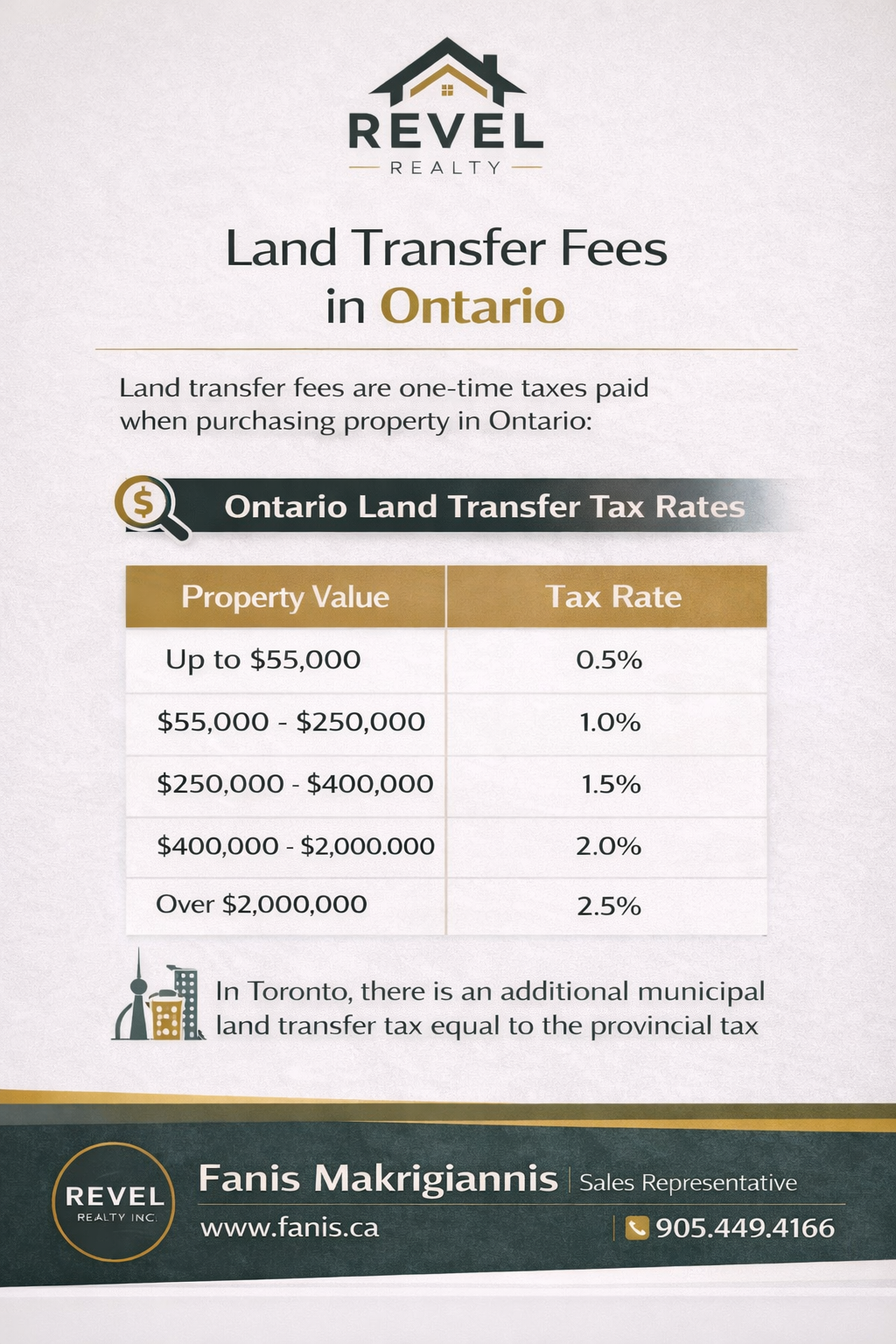

The land transfer fee must be paid as a lump sum. You cannot add it to your mortgage balance or pay it in installments. Your lawyer typically arranges this payment. You must prepare to pay the land transfer fee as a single, upfront payment. This fee cannot be financed by adding it to your mortgage, nor can it be broken down into smaller, manageable installments. 

Fanis Makrigiannis Real Estate Agent Oshawa
Your lawyer will typically arrange for this lump sum payment, usually facilitated through the Statement of Adjustments, ensuring the funds are transferred appropriately during the closing process. 

As a trusted Realtor® in the Durham Region, I always advise clients to budget for this significant expense separately from their mortgage.

Calculating the Cost of Land Transfer Fees


Homebuyers should budget 1-1.5% of the property value for this tax. You calculate this based on the sale price, assessed value, or mortgage amount. For instance, a property valued at $300,000 in Ottawa incurs a $2,725 tax.

Determining value based on sale price or mortgage principal


You will determine the land transfer tax using the greater of the property's sale price, assessed value, or mortgage amount. This ensures a 

consistent calculation method for all transactions.

Tiered tax rates and Ontario cost examples


Ontario's land transfer tax uses a tiered system, meaning different portions of the property value are taxed at varying rates. For example, a property valued at $300,000 in Ottawa results in a $2,725 tax. Understanding the tiered tax rates is imperative. 

The tax applies progressively, so higher property values mean you pay a higher percentage on the top tiers. A Realtor® in the Durham Region can help you accurately estimate your specific land transfer tax obligations, providing clarity on your total purchasing costs.
 

What are land transfer fees in Ontario?


Regional Variations and Municipal Tax Structures


Tax collection for land transfer fees in Ontario is not uniform across the province. Most areas only require you to pay the provincial land transfer tax. However, you will find that some municipalities have additional taxes. Other regions like Montreal offer full refunds for families with children under 18 or those expecting within nine months, demonstrating how exemptions can vary significantly.

The dual-tax system in the City of Toronto


Purchasing property in Toronto means you face a dual-tax system. You will pay both the provincial land transfer tax and an additional municipal land transfer tax unique to the city. This makes Toronto one of the most expensive places to buy property in terms of land transfer fees.

Municipal programs and family-based exemptions


You might find that certain regions, such as Montreal, offer full refunds for specific demographics. Families with children under 18, or those expecting a child within nine months, can benefit from these significant exemptions. These programs aim to support families and make homeownership more accessible.

Fanis Makrigiannis Real Estate Agent
These specific exemptions, such as those found in Montreal, highlight how municipal policies can directly impact your closing costs. 

While Ontario does not currently have identical programs, understanding these variations is important for anyone considering purchasing property across different regions. 

As a Realtor® in the Durham Region, I can inform you about the specific provincial taxes you will encounter here, ensuring you are fully prepared for your land transfer fee obligations.

Rebates for First-Time Homebuyers


First-time buyers in Ontario are eligible for a refund of up to $4,000, which can reduce the tax to $0 for certain purchases. 

These eligibility criteria are set by provinces or municipalities to help ease the financial burden on new owners, a welcome relief for those entering the market. For more details on these rates, you can explore the Ontario Land Transfer Tax Rates 2026 | Calculator.

Eligibility criteria for provincial tax refunds


You must meet specific provincial or municipal criteria to qualify for these tax refunds. These guidelines are in place to ensure the rebate genuinely assists those purchasing their first home.

Maximum rebate amounts and the claim process


You can receive a maximum rebate of $4,000, potentially eliminating the land transfer tax on certain purchases. The process for claiming this refund involves submitting an application with your property transfer documents. 

This significant rebate of up to $4,000 is designed to provide substantial financial relief, making homeownership more accessible. For some transactions, this refund can completely offset the land transfer tax, a considerable benefit for new buyers. Your Realtor® in the Durham Region can guide you through the necessary paperwork and ensure you meet all requirements for a successful claim.

What are land transfer fees in Ontario?


Legal Exemptions and Tax Status


You find certain legal exemptions apply to land transfer fees in Ontario. Transfers between spouses or to direct descendants like parents, siblings, or grandparents are often exempt. This tax is not a sales tax, unlike GST/HST on new builds, and you cannot deduct it or claim it as an income tax write-off. For more information on What is Land Transfer Tax?, consult a Realtor® in the Durham Region.

Family-related transfer exemptions


Exemptions frequently apply to transfers involving close family members. You will find that transfers between spouses, or to descendants such as parents, siblings, or grandparents, are often not subject to land transfer tax. This provides significant relief for changes to family property.

Comparison with sales tax and income tax regulations


You should understand that the land transfer tax operates differently from other taxes. It is not a sales tax like GST/HST on new builds, and you cannot deduct it or claim it as an income tax write-off. This distinction is critical for your financial planning.


You might compare the land transfer tax to other levies, but it is distinct in nature. This tax is not a sales tax, differentiating it entirely from GST/HST you pay on new builds. You also cannot claim it as a tax-deductible expense, nor is it eligible for income tax write-offs. This means it functions as a standalone cost in your property transaction, separate from typical income or consumption taxes.

Fanis Makrigiannis Real Estate Agent Oshawa

To wrap up


Taking this into account, land transfer fees are a mandatory, non-deductible closing cost in Ontario. You must budget carefully for these fees. For impartial guidance and competitive rates on property financing, consider consulting professionals like nesto's commission-free digital experts. If you have further questions, please contact your Realtor® in the Durham Region.

Q: What are land transfer fees in Ontario, and who pays them?


A: Land transfer fees, commonly known as land transfer tax, are a mandatory payment homebuyers make to the Province of Ontario when a property's title transfers into their name. This fee is distinct from other closing costs, such as legal and appraisal fees. The buyer is solely responsible for paying this tax; sellers do not incur this expense. 

These taxes serve as a revenue source for the province and, in some municipalities, for the city as well. For those considering buying a home in the Durham Region, understanding this cost is an important step in budgeting for your purchase.

Q: How are land transfer fees calculated in Ontario, and are there any exemptions for first-time homebuyers?


A: Land transfer fees in Ontario are calculated based on a tiered system related to the property's purchase price. The higher the purchase price, the higher the percentage of the value that is taxed. You can find specific calculators on the Ontario Ministry of Finance website or through your legal professional. A Realtor® in the Durham Region can also help you understand these costs. 

First-time homebuyers in Ontario are eligible for a refund on a portion of the provincial land transfer tax, up to a maximum of $4,000. This refund can significantly reduce the amount owed, and in some cases, eliminate it for lower-priced homes. Eligibility criteria apply, so consulting with a real estate lawyer or an experienced Durham Region real estate agent can confirm if you qualify.

Q: When and how do I pay land transfer fees in Ontario, and can they be avoided?


A: Buyers pay land transfer fees as a one-time lump sum on the closing day of their property purchase. Your real estate lawyer handles the arrangement of this payment when the property deed officially transfers into your name. Unlike ongoing property taxes, the land transfer tax is a singular event. 

While specific exemptions exist, such as transfers between spouses or certain family members, generally, avoiding land transfer taxes is not possible. The tax is a legally required part of the property purchasing process in Ontario. Consulting a legal professional is the best way to understand all tax obligations and potential exemptions relevant to your specific situation.

About the author:

Fanis Makrigiannis Real Estate Services
Fanis Makrigiannis is a trusted Realtor® with Revel Realty Inc., specializing in buying, selling, and leasing homes, condos, and investment properties. Known for his professionalism, market expertise, and personal approach, Fanis is a Real Estate agent in the Durham region and is committed to making every real estate journey seamless and rewarding.

He understands that each transaction represents a significant milestone and works tirelessly to deliver outstanding results. 

With strong negotiation skills and a deep understanding of market trends, Fanis fosters lasting client relationships built on trust and satisfaction.

Proudly serving the City of Toronto • Ajax • Brock • Clarington • Oshawa • Pickering • Scugog • Uxbridge • Whitby • Prince Edward County • Hastings County • Northumberland County • Peterborough County • Kawartha Lakes